
Taylor County Court Records After Arrest
After a Taylor County arrest, local law enforcement and regional jail intake create the custody side of the record. The next step is court action. West Virginia magistrate rules require an arrested person to be taken before a magistrate without unnecessary delay. At that first appearance, the magistrate may address the complaint, probable cause, bond, release conditions, or a hold that prevents release. The court records after a jail arrest are not just a copy of the jail entry. They are the criminal case file and docket created as the charge moves through magistrate or circuit court.
For Taylor County, the jail roster side runs through the West Virginia Division of Corrections and Rehabilitation regional jail systems, not a sheriff-run local roster. Tygart Valley Regional Jail and Correctional Facility is the regional facility to check for custody. The court side belongs to the magistrate and circuit courts. Use Taylor County jail inmate records for custody and booking details, and use Taylor County jail mugshots for booking-photo limits. For charges, hearings, warrants, and dispositions, court records after arrest need the official case systems and clerk offices.
Taylor County Arrest to Court Path
The basic path is arrest, booking, first appearance, charging decision, then case tracking. Magistrate court handles misdemeanor cases, preliminary felony examinations, warrants, bail, and other lower-court criminal matters. Circuit court is the general jurisdiction trial court of record in West Virginia and handles felony cases and some misdemeanor matters. Taylor County felony cases may start with magistrate proceedings and then move toward circuit court by information, indictment, or later court order.
Taylor County Prosecuting Attorney John L. Bord is the county's chief legal officer for criminal prosecution. The official prosecutor page says the office prosecutes misdemeanors and felonies, requests warrants for persons charged with felonies, tries cases before magistrate and circuit judges, and presents information to the grand jury for indictment. That prosecutor role is why roster charges may change after a jail arrest. A jail admission can reflect arrest-side wording, while the court record reflects the charge filed, amended, reduced, dismissed, or proved in court.
Note: A jail roster entry helps locate the person, but the court docket controls the formal charge status.
Find Taylor County Court Records
Taylor County court records after an arrest can require more than one search because West Virginia separates magistrate and circuit access. The Magistrate Case Record Search is the starting point for many misdemeanor cases, criminal complaints, preliminary felony matters, bond events, and warrant-related magistrate filings. The state judiciary says the magistrate search is free, can be searched by name or case number, and returns up to 30 records. Court documents are not available through that magistrate search, so copies must be requested from the clerk in the county where the case was filed.
- Use the DCR regional jail search or daily incarcerations page to confirm the person, custody facility, and likely booking date.
- Search the magistrate case system by name or case number for complaints, misdemeanors, warrants, bond entries, and preliminary felony matters.
- Search WVPASS for Taylor County circuit court records when the case is a felony or has moved past the magistrate stage.
- Open the case result and compare charge text, case number, filing date, hearings, and disposition entries against the jail information.
- Contact the Taylor County Magistrate Clerk or Circuit Clerk when online results are too broad, missing, or require document copies.
The West Virginia Judiciary's court-record access page links the public to both circuit and magistrate tools. WVPASS provides circuit court access across all 55 counties, with public documents dating back to 1999 where they are available. Search is free. Public document downloads may carry a per-page charge and card processing fee. The Judiciary Taylor County court page remains the point of confirmation for local clerk names, phone numbers, and courthouse office details.
The state court-record access page is the official source for choosing between circuit and magistrate searches.
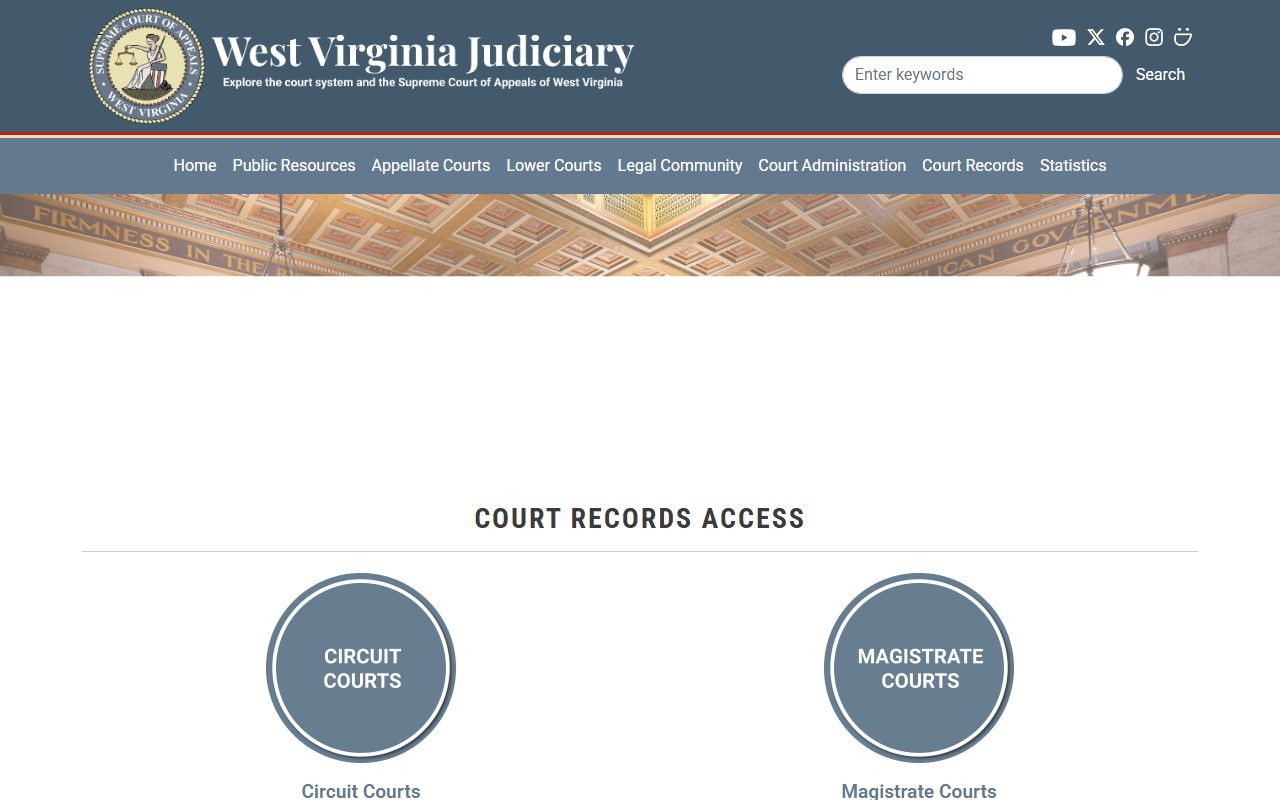
Use the court access landing page to avoid mixing up a jail custody lookup with a criminal case lookup.
Taylor County Magistrate Search Fields
The magistrate case system is broad enough to return same-name results from more than one county, so a careful search matters. Use full names when possible. If a case number is known from a citation, warrant, complaint, or clerk notice, enter it as shown. The Judiciary explanation notes that the system can be searched by first name, last name, or case number, and that the result list is capped.
| Field | Use | Notes |
|---|---|---|
| First name | Defendant name search | Useful with last name when common names create broad results. |
| Last name | Defendant name search | Use enough letters to narrow the statewide index. |
| Case number | Exact case lookup | Enter the number exactly as displayed, including dashes when shown. |
| County | Result filter or result identifier | Confirm the case is filed in Taylor County before relying on it. |
| Search button | Runs the query | Magistrate results may be limited to 30 records. |
Court Charges After Jail Arrest
Charges can enter Taylor County court records through different documents. A complaint is often used at the magistrate stage and may support an arrest warrant, first appearance, or preliminary handling. An information is a prosecutor-filed charging document. An indictment is a grand jury charging document, most often tied to felony prosecution. Each document can name offenses that differ from the quick charge text seen in a jail admission or regional jail profile.
| Complaint | Information | Indictment | |
|---|---|---|---|
| Filed By | Officer or prosecutor through magistrate process | Prosecuting attorney | Grand jury after prosecutor presentation |
| Common For | Misdemeanors, warrants, and preliminary felony matters | Felony cases that proceed by prosecutor filing | Felony cases presented to a grand jury |
| Where It Appears | Magistrate case records | Circuit case records | Circuit case records |
| Why It Matters | Starts or supports the first court record | Sets the formal circuit charge | Sets the grand-jury charge |
Taylor County Charge Status Terms
Charge status can change as a Taylor County case moves through court. A prosecutor may amend the charge, reduce it, dismiss one count while another remains, or proceed to a plea or trial. That is why court records after a jail arrest must be checked after the first booking entry. The first jail charge may be a police or intake label. The court record shows what the prosecutor filed and what the judge later ordered.
| Status | What It Means |
|---|---|
| Pending | The charge or case is still active and no final disposition has been entered. |
| Amended | The charge text, code, count, or filing basis changed by prosecutor or court action. |
| Reduced | The charge was lowered to a lesser offense or lower level. |
| Dismissed | The court ended that charge without a conviction on that count. |
| Nolle prosequi | The prosecution declined to continue that charge, often called a dropped charge. |
| Conviction | A guilty plea, guilty verdict, or adjudicated guilt was entered. |
| Acquittal | A not guilty finding was entered after trial. |
Bond After Taylor County Arrest
Bond is tied to the first court appearance and to later court orders. West Virginia magistrate rules require prompt magistrate review after arrest, and magistrate administrative rules address situations where a person has been arrested or can post bond. Taylor County Magistrate Court can be reached through the magistrates at 304-265-1322 or the Magistrate Clerk at 304-265-5762. Tygart Valley Regional Jail can confirm whether the person is held there and whether another hold may block release.
| Bond Type | How It Works |
|---|---|
| Cash bond | Money is paid under court order. Confirm amount, location, and payee before payment. |
| Surety bond | A bonding company or surety guarantees appearance. A separate hold can still block release. |
| Personal recognizance | Release is based on a written promise and court conditions instead of upfront money. |
| Property or security bond | Property or collateral secures appearance. Clerk instructions control required documents. |
| No-bond hold | Release is unavailable until further court action or another agency clears its hold. |
No official Taylor County page was located with public bond-payment methods, after-hours bond posting rules, or bondsman procedures for Tygart Valley. Confirm details with the jail and court before sending money or relying on a third-party statement.
Taylor County Warrant Records
No official Taylor County Sheriff active warrant search page was located in the research. Warrant checks therefore run through court and clerk channels. Magistrate courts issue arrest and search warrants and conduct preliminary felony examinations. The prosecutor page says the prosecuting attorney requests warrants for persons charged with felonies. Sheriff Randy Durrett's official Taylor County Sheriff page describes the sheriff's role in executing court process and enforcing court orders.
For a magistrate warrant, call Taylor County Magistrate Court at 304-265-1322 or the Magistrate Clerk at 304-265-5762, subject to public-access limits and safety instructions. For felony or circuit-level warrant activity, search WVPASS or contact the Taylor County Circuit Clerk. A warrant arrest may create a DCR booking entry, but the warrant basis and case status should be verified with court records.
Taylor County Charges vs Convictions
A charge is an accusation. A conviction is a final court outcome based on a guilty plea, verdict, or adjudication. Taylor County court records after an arrest can show both, but they are not the same thing. A person may be arrested and charged, then have a charge dismissed, amended, reduced, or resolved without conviction if the law and facts support that outcome.
| Charge | Conviction | |
|---|---|---|
| Stage | Accusation filed or pursued in court | Final guilty outcome by plea, verdict, or adjudication |
| Proof Level | Based on complaint, probable cause, or prosecutor filing | Requires proof beyond a reasonable doubt or a valid guilty plea |
| Case Status | May be pending, amended, reduced, or dismissed | Appears as a disposition or judgment entry |
| Record Use | Should not be treated as guilt | Still must be verified with the court that entered it |
Sealed and Expunged Arrest Records
West Virginia expungement laws may affect public access after an acquittal, dismissal, deferred adjudication, pretrial diversion, or eligible conviction. W. Va. Code 61-11-25 addresses certain arrest and charge records. W. Va. Code 61-11-26 addresses certain criminal convictions. Eligibility depends on the charge, outcome, waiting period, prior record, and court order.
| Sealed | Expunged | |
|---|---|---|
| Public Visibility | Hidden from general public access by court order | Removed or treated by law as no longer publicly available in the covered record |
| Record Holder | Court and agency instructions control access | Court order directs how covered records are handled |
| Eligibility | Depends on West Virginia statute and case outcome | Depends on the specific expungement statute and court findings |
| Next Step | Check the order and clerk instructions | Use the signed expungement order with each record holder |
Restricted Taylor County Court Records
West Virginia FOIA creates broad access to public records, but W. Va. Code 29B-1-4 includes exemptions that can affect law-enforcement, privacy, and investigative records. Juvenile matters, sealed cases, expunged records, sensitive victim information, and active investigative material may be restricted. Court clerks can explain access to public case documents, but they do not provide legal advice about whether a person qualifies to seal or expunge a record.
Important: Taylor County Inmate Population is not a consumer reporting agency, and these records may not be used for FCRA-covered decisions.